
Patriot Platform Should Be Outlawed as Terror Group, Demands Labour Peer After Dover and Portsmouth Protests
A senior Labour peer has called on the UK Government to consider outlawing Patriot Platform as a terrorist organisation following a series of highly disruptive anti-migrant protests in Dover and Portsmouth.
Shami Chakrabarti, the former director of civil liberties organisation Liberty and a former Labour shadow attorney general, has argued that the group’s recent activities raise serious questions about violence, intimidation and the limits of political protest. Her intervention comes after masked and hooded demonstrators gathered in large numbers on the south coast, blocking roads and confronting police and emergency services.
Chakrabarti is not simply calling for tougher policing of individual protesters. Instead, she has suggested that ministers should examine whether Patriot Platform meets the legal threshold for proscription under the Terrorism Act 2000.
That would be an extraordinary step, because proscription carries major legal consequences. Once an organisation is formally proscribed, membership and certain forms of support for it become criminal offences.
The debate therefore reaches far beyond the protests themselves. It raises difficult questions about where the boundary lies between political dissent, public disorder and organised extremist activity.
A new focus for the immigration protest movement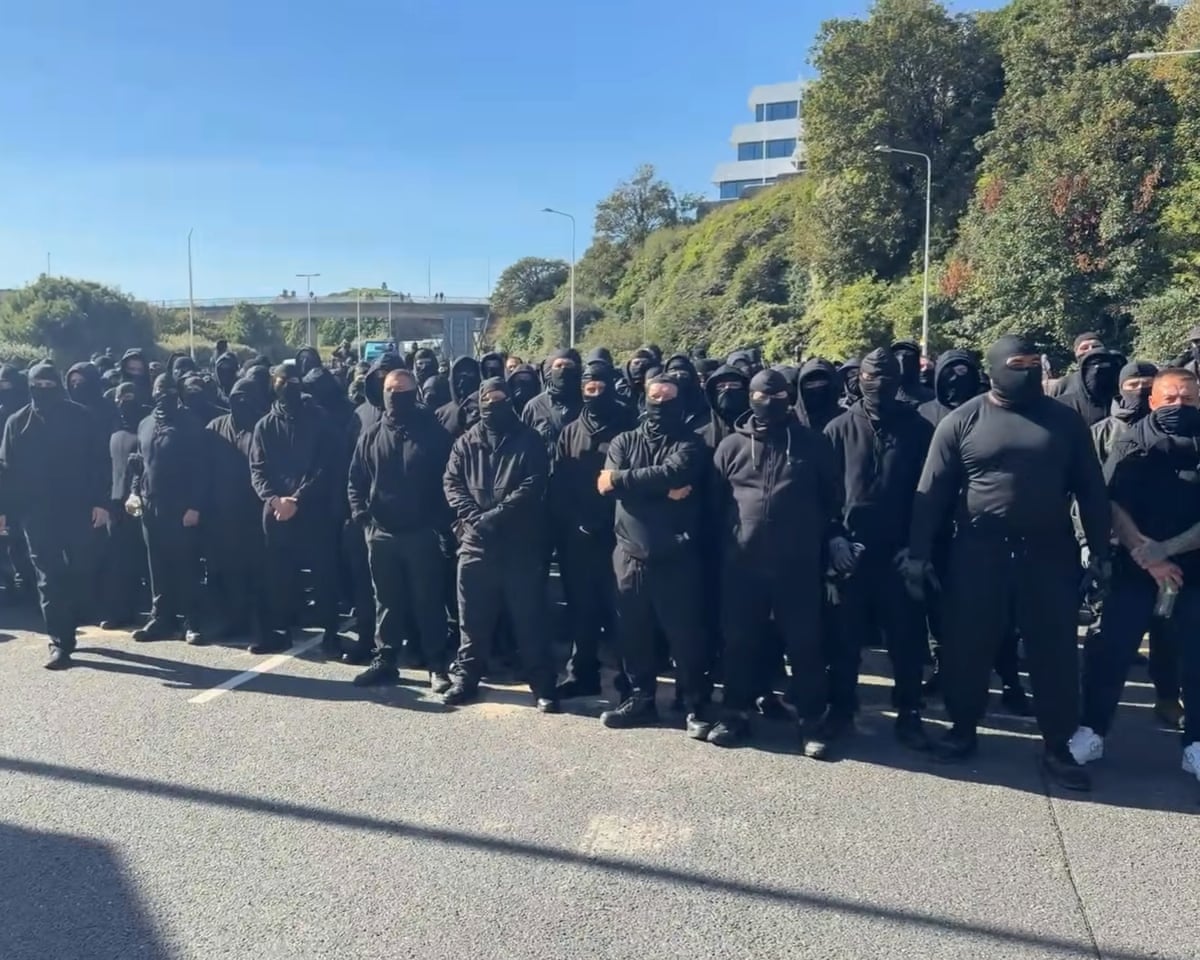
Patriot Platform has emerged as a prominent name within Britain’s increasingly visible anti-migrant protest movement.
The organisation is associated with Daniel Thomas, commonly known online as Danny Tommo, who has been linked to far-right activist Stephen Yaxley-Lennon, better known as Tommy Robinson.
According to reporting on the group, Patriot Platform brings together activists from a number of local anti-migrant groups. Thomas has used social media to mobilise supporters and has presented the movement as an organised campaign against illegal immigration.
Its profile increased sharply after protests in Dover and Portsmouth in September.
In Dover, hundreds of demonstrators dressed predominantly in black, with many wearing balaclavas or other face coverings, gathered close to the port. Roads were blocked, creating significant disruption for traffic entering and leaving one of Britain’s most important international transport hubs.
National Highways reported delays stretching for several miles during the protest.
The demonstrations were centred on opposition to small boats carrying asylum seekers across the Channel, with protesters chanting anti-migration slogans and demanding action against the crossings.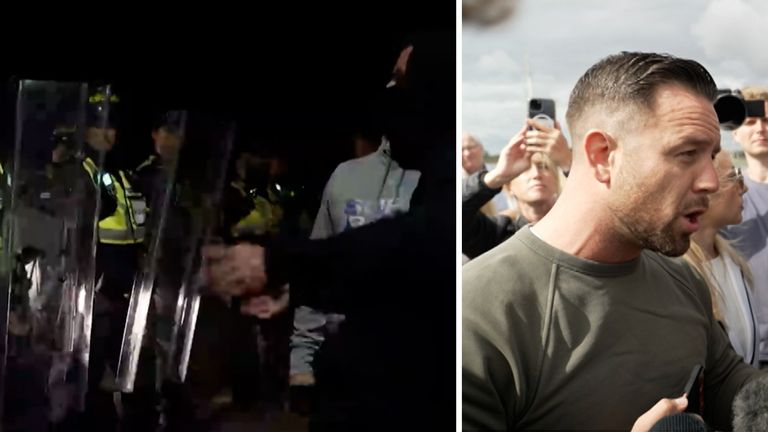
The following day, a much larger confrontation unfolded in Portsmouth after a boat carrying asylum seekers arrived in the area.
Police were required to manage a crowd that remained at the scene into the early hours. Authorities later said that police, coastguard and Border Force vehicles had been damaged, while some officers suffered minor injuries. Investigations were launched into allegations including assault and criminal damage.
For ministers, the events presented a difficult challenge.
The Government has repeatedly defended the right to peaceful protest, but has also insisted that demonstrations cannot cross into violence, intimidation or serious public disorder.
That distinction has become central to the argument over Patriot Platform.
Chakrabarti’s intervention
Chakrabarti has now brought the question of proscription directly into the political debate.
In remarks reported by The Independent, she argued that Patriot Platform appeared to go beyond conventional political protest and suggested that its organisation and presentation could be associated with intimidation.
She pointed particularly to the use of coordinated black clothing and face coverings, describing the appearance as resembling a “private army”.
Her argument is notable because Chakrabarti previously opposed the Government’s decision to proscribe Palestine Action under terrorism legislation.
She has maintained that peaceful political activists should not automatically become subject to terrorism laws because some individuals associated with a movement commit offences.
However, she argues that the circumstances surrounding Patriot Platform deserve separate consideration.
In her view, the relevant issue is not whether politicians agree with the political objectives of one movement or another, but whether an organisation is involved in conduct that meets the legal definition required for proscription.
That distinction is important because terrorism legislation is not simply another tool for dealing with disruptive demonstrations.
What would a ban actually mean?
Under the Terrorism Act 2000, the Home Secretary can proscribe an organisation if they believe it is concerned in terrorism and that proscription is proportionate.
A proscribed organisation can face severe restrictions. Belonging to such an organisation or inviting others to support it can become criminal offences.
That means the Government would have to consider substantial legal and evidential questions before taking such a step.
The existence of aggressive demonstrations or criminal acts by individuals does not automatically mean that an entire organisation satisfies the statutory definition of terrorism.
This is likely to be one of the central issues in any future debate.
The Government would need to distinguish between individual criminality, organised violence, political extremism and conduct that falls within the specific legal framework of terrorism legislation.
For that reason, Chakrabarti’s demand represents a call for consideration rather than an announcement that Patriot Platform has already been classified as a terrorist organisation.
Dover and Portsmouth changed the debate
The scale and appearance of the south-coast protests have nevertheless intensified concerns about the direction of anti-migrant activism.
In Dover, demonstrators managed to disrupt traffic around the port. Police later faced questions about whether sufficient intelligence had been gathered before the protest.
The Kent force initially described the demonstration as spontaneous, despite concerns that the organisers had signalled their intentions beforehand. Local Labour MP Mike Tapp questioned whether authorities had missed important warnings.
Portsmouth presented an even more difficult situation.
Hundreds of people gathered after the arrival of asylum seekers, with some attempting to interfere with the movement of those being taken for processing.
The police response continued for hours, and officials subsequently investigated alleged assaults and damage to vehicles.
Downing Street condemned the behaviour and drew a distinction between legitimate protest and disorder.
The Government’s position reflects a wider concern: political frustration over immigration is permitted in a democratic society, but physical confrontation with police or attempts to obstruct emergency operations can create serious public-safety consequences.
The RNLI controversy
The protests have also had consequences beyond the immediate demonstrations.
The Royal National Lifeboat Institution became a target of criticism after its crews rescued people attempting to cross the Channel.
The RNLI has stressed that its volunteers rescue people without judging their nationality or circumstances. It has also rejected claims circulating online that the charity is involved in secretly transporting or housing migrants.
The controversy escalated to the point that Portsmouth’s lifeboat station temporarily closed after being affected by protests and security concerns.
The RNLI subsequently advised volunteers to consider whether wearing branded clothing could expose them to risk and said staff should be able to close facilities when they felt unsafe.
The organisation has pointed out that Channel small-boat incidents represent only a small proportion of its overall rescue activity. In 2025, RNLI lifeboats launched more than 9,000 times, with 109 callouts involving small boats in the Channel.
The episode demonstrates how immigration protests can quickly affect organisations whose primary purpose is emergency rescue rather than political campaigning.
A broader argument over extremism
Chakrabarti’s intervention also raises a broader question about how Britain responds to extremist movements.
Her supporters may argue that authorities cannot apply different standards depending on whether a movement’s political message is popular or unpopular.
Others may warn that extending terrorism legislation into political protest could create a dangerous precedent.
That tension has already appeared in the controversy surrounding Palestine Action, whose proscription has been criticised by civil-liberties campaigners who argue that violent acts by individuals should be dealt with through ordinary criminal law rather than automatically treating an entire movement as terrorist.
Chakrabarti herself has previously taken that position, making her call for consideration of Patriot Platform particularly significant.
The legal question will therefore matter as much as the political one.
What happens next?
There is currently no indication that Patriot Platform has been formally proscribed under the Terrorism Act.
Instead, the immediate pressure is on ministers and law-enforcement agencies to assess the group’s activities and determine whether existing laws are sufficient.
Home Secretary Shabana Mahmood has separately condemned Daniel Thomas and said that criminal behaviour associated with anti-migrant protests would face legal consequences. She has also stressed the distinction between legitimate community concerns and extremist attempts to exploit those concerns.
For the Government, the challenge is complicated.
Immigration remains one of Britain’s most contentious political issues, and public concern about small-boat crossings cannot simply be removed through policing.
At the same time, allowing organised demonstrations to develop into road blockades, clashes with officers or intimidation of emergency workers presents a separate problem.
The Patriot Platform controversy has therefore become a test of where Britain draws the line.
Chakrabarti wants ministers to consider whether the organisation has crossed that line far enough to justify terrorism proscription. Whether the Government ultimately agrees will depend on legal assessments, evidence about the organisation’s activities and the proportionality of using Britain’s most powerful counter-terrorism laws.
For now, Patriot Platform remains at the centre of a rapidly developing argument about immigration, protest, public order and extremism.