
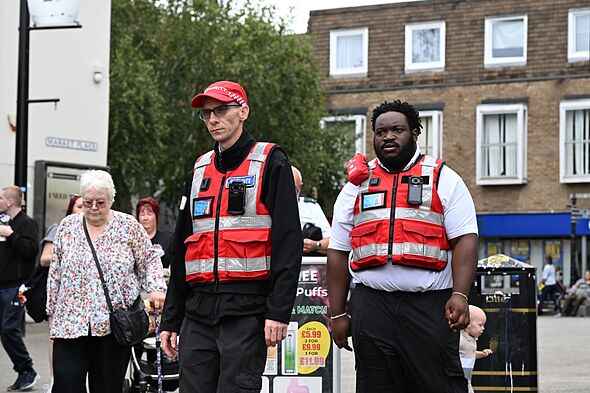
Security guards deployed by Essex County Council patrol in Braintree town centre (Image: Will Colebourne/PA Wire)
A high street near a huge migrant centre has allegedly been turned into a “ghost town”, with locals claiming they are too frightened to go out. Residents in Braintree, Essex, have spoken of alleged intimidation and sexual harassment involving asylum seekers who are regularly brought into the town from the nearby Wethersfield accommodation centre.
Some women have claimed they have been approached or surrounded by groups of migrants, while one grandmother said she had given her teenage grandchildren rape alarms because she feared for their safety. Braintree is close to the former military base at Wethersfield, which is currently home to 1,245 migrants. The site houses single male asylum seekers aged between 18 and 65 while their claims are processed, with groups transported by minibus into Braintree, as well as Chelmsford and Colchester.
Get the day’s biggest headlines in UK and World news and more
Invalid email
You agree you are 18 or over. We use your sign-up to provide content in ways you’ve consented to and to improve our understanding of you. This may include adverts from us and third parties based on our knowledge of you. You can unsubscribe at any time. More Info.

Security guards deployed by Essex County Council patrol in Braintree town centre (Image: Will Colebourne/PA Wire)
Annette Lucas, 74, said she had bought rape alarms for her grandchildren, aged 16 and 13, because she considered the town centre a “scary” place.
She told The Sun: “You’re not safe here. I bought them all rape alarms because they’re really loud.”
Mrs Lucas also claimed groups of migrants had surrounded her grandchildren and said they were afraid to come into the town.
Valerie Spurgeon, 80, claimed she was once surrounded by three asylum seekers after withdrawing her pension money.
She said she crossed the road to a supermarket for safety after telling them she “wasn’t very polite”.
Ms Spurgeon claimed the youngest man then made a sexually abusive remark towards her.
Another woman, who asked not to be named, alleged an asylum seeker had told her on the high street that he would “like to f*** her”.
Local man Daniel Davies, 51, said he had heard reports of women being wolf-whistled at and described groups of young men around the bus station as intimidating.
He said: “There’s a real fear in this community at the moment. As you can see, the town’s like a ghost town, especially on a Thursday.”
But not everyone in Braintree shared those concerns.
Leslie Lewis, 72, said she regularly travelled into the town by public transport and had never experienced trouble involving asylum seekers.
Get top stories from The Express sent straight to your phone Join us on WhatsApp
Our community members are treated to special offers, promotions, and adverts from us and our partners. You can check out at any time. Read our Privacy Policy
She said those waiting for their minibuses were kept apart from other people and “don’t interfere with anyone”.
Gary Waddington, 75, also said he had never personally witnessed problems involving asylum seekers and said he did not want Braintree portrayed as a frightening place.
Essex Police maintains Braintree is safe and says crime in the town is lower than it was three years ago, when the Wethersfield accommodation centre opened.
The force said 15 offences had been reported across Essex since June 2023, in which a member of the public was the victim and the suspect was identified as an asylum seeker from Wethersfield.
Police said neighbourhood teams patrol Braintree, Chelmsford and Colchester every day, including at key times, to provide reassurance and deter crime and anti-social behaviour.
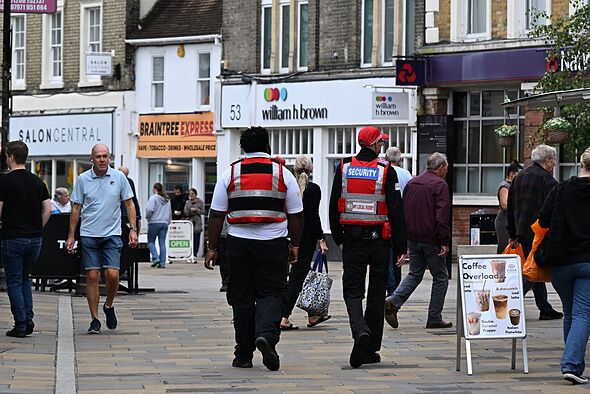
The concerns have nevertheless prompted a new security operation in Braintree town centre.
Operation Vanguard, introduced by the Reform-led Essex County Council, is a three-month trial funded through up to £150,000 from a community improvement fund. It is expected to cost around £118,000 plus VAT.
The private security operatives patrol between 10am and 6pm, seven days a week, but have no enforcement powers and must refer criminal matters to police.
Essex County Council leader Peter Harris said residents had been raising concerns for months over the daily bussing of asylum seekers into local towns.
Braintree District Council leader Tom Cunningham stressed that Braintree remained “a safe place to live, work and visit” and said action affecting the town centre should be based on evidence.
The Home Office said it works closely with police to ensure the safety of communities around Wethersfield.
Andy Burnham’s ‘Pathetic Love-In’ Is a Huge Mistake – Donald Trump Will Make Him Regret It
Andy Burnham and Donald Trump appear to be heading towards a relationship that could become one of the most closely watched political encounters of the coming years.
The British prime minister and the American president come from very different political traditions. Their public positions have frequently diverged, particularly on issues involving energy, foreign policy and the future of the international order. Yet since Burnham entered Downing Street, both sides have signalled an interest in maintaining a functioning relationship between Britain and the United States.
That has inevitably produced a political paradox.
Burnham has previously been highly critical of Trump and his style of politics. Trump, for his part, publicly described Burnham as “extremely liberal” during the British leadership transition and questioned whether the new prime minister would support greater oil exploration in the North Sea.
Yet the tone changed once Burnham became prime minister.
On 20 July 2026, Trump said he had had a “very good conversation” with Burnham. According to Reuters, the two discussed North Sea oil, trade, military cooperation, the reopening of the Strait of Hormuz and other subjects. Trump also said the two leaders would meet in the near future.
For some critics, this warmer diplomatic tone will look like an uncomfortable reversal.
For others, it is simply what international politics requires.
From political criticism to diplomatic necessity
Burnham’s previous comments about Trump are well documented.
During the 2026 political campaign, Burnham criticised what he described as the increasingly polarised and poisonous nature of American politics. He had also criticised Trump’s conduct following the 2021 attack on the US Capitol.
That history makes the new relationship particularly interesting.
It is one thing for a British politician to criticise an American president from opposition or from local government. It is another thing entirely when that politician becomes prime minister and must deal directly with Washington.
The United States remains one of Britain’s most important allies. Defence cooperation, intelligence sharing, trade, diplomacy and international security all require communication between the two governments.
A British prime minister cannot simply choose to ignore the American president because of political disagreements.
That is the fundamental reality behind Burnham’s new approach.
The phone call that changed the tone
The first conversation between the two leaders provided an early indication of how the relationship might develop.
Trump publicly characterised the discussion as positive, while Burnham’s government indicated that the conversation covered important areas of bilateral cooperation.
The significance of the conversation was not necessarily that Burnham and Trump had suddenly become political allies.
Rather, it demonstrated that personal political differences could coexist with diplomatic engagement.
That distinction matters.
Governments frequently negotiate with leaders whose domestic policies they oppose. Diplomacy does not require friendship, and disagreement does not necessarily prevent cooperation.
Burnham himself subsequently made this point.
In a major BBC interview, he said he would be prepared to disagree publicly with Trump if doing so was necessary to defend Britain’s interests. He stressed that the national interest would come before personal relationships.
That statement provides an important qualification to the idea that Burnham is simply embracing Trump.
Why critics are suspicious
Nevertheless, the optics are politically complicated.
Trump is a highly controversial figure in Britain, and Burnham has previously criticised his political approach. Consequently, any display of warmth between the two leaders can become a target for political opponents.
The phrase “love-in” suggests something much stronger than a normal diplomatic relationship. It implies excessive enthusiasm or personal closeness.
There is evidence for a warm initial exchange: Trump described his conversation with Burnham positively, while Burnham said that his first interaction with the president had been warm. But that does not establish that the two leaders share a broader political outlook.
In fact, there are already significant areas of disagreement.
North Sea oil
Energy policy is one obvious fault line.
Trump has repeatedly advocated greater oil and gas production and criticised policies that restrict fossil-fuel development. During his first public comments about Burnham, Trump specifically linked the prime minister’s political outlook to the question of North Sea oil exploration.
Burnham faces a different political calculation.
Britain has to balance energy security, household costs, investment, climate commitments and the future of domestic energy production.
The North Sea remains economically and politically important, but Britain’s energy strategy is also tied to longer-term questions about renewable energy, electricity infrastructure and dependence on international markets.
A disagreement between London and Washington over energy policy would therefore not necessarily mean a breakdown in the wider relationship.
It would simply demonstrate that allies can have different domestic priorities.
Foreign policy could become more difficult
The most serious tensions may arise from international affairs.
Burnham has already indicated that he is willing to disagree with Trump publicly if he believes Britain’s interests require it. This position became particularly relevant during debates over US military action and Britain’s role in international conflicts.
Defence Secretary Wes Streeting has similarly emphasised that Britain can cooperate with Washington while maintaining disagreements over particular military operations.
This could become one of the defining features of the relationship.
Britain needs the United States for many aspects of its defence and security architecture. At the same time, British governments retain their own foreign-policy objectives and legal responsibilities.
The challenge is therefore not whether Britain should agree with Washington on everything.
It is how disagreements can be managed without damaging essential cooperation.
The Trump factor
Donald Trump’s approach to alliances has often placed greater emphasis on national interests and burden-sharing than previous US administrations.
That creates both opportunities and risks for Britain.
A British government that wants a close relationship with Washington must demonstrate that cooperation is meaningful. At the same time, it must avoid creating the impression that British policy is simply following American preferences.
For Burnham, this balancing act may be particularly important because of his previous criticism of Trump.
If he becomes too accommodating, opponents could accuse him of abandoning positions he previously defended.
If he becomes too confrontational, the relationship with Washington could become unnecessarily difficult.
The middle ground is therefore politically demanding.
Will Trump make Burnham regret the relationship?
The headline’s suggestion that Trump will eventually make Burnham “regret” the relationship is ultimately a prediction rather than an established fact.
There are several possible ways the relationship could develop.
Trump and Burnham could discover areas where cooperation is relatively straightforward, particularly in defence, trade and international security.
Alternatively, disagreements over Iran, energy, trade, Europe or constitutional issues could become increasingly difficult.
There is also the possibility that both leaders will simply learn to compartmentalise their differences.
The latter approach is common in international diplomacy. Governments do not need to agree on every question in order to cooperate where their interests overlap.
Indeed, recent events suggest that this may already be the direction being pursued.
The Irish question
One especially sensitive area is Northern Ireland.
Trump recently expressed support for the eventual unification of Ireland, a position that differs from the British government’s approach. Burnham’s office subsequently reaffirmed that the UK government’s position on Irish unity had not changed.
This is a clear example of how quickly differences between London and Washington can emerge.
The issue is particularly sensitive because Northern Ireland’s constitutional future is governed by the principles established under the Good Friday Agreement.
For a British prime minister, the subject cannot be treated simply as another foreign-policy disagreement.
It involves the constitutional structure of the United Kingdom and the political balance within Northern Ireland.
The coming meeting
The next major test could come when Burnham and Trump meet face-to-face.
The two leaders are expected to meet during the United Nations General Assembly in New York. According to reports, the meeting would give them an opportunity to discuss Ukraine, defence, the Middle East and other areas of international policy.
The encounter will inevitably attract considerable attention because of their contrasting political histories.
Burnham has criticised Trump’s politics.
Trump has questioned Burnham’s political outlook.
Yet both now occupy positions that require cooperation.
That contradiction is precisely what makes their relationship so interesting.
A relationship built on interests, not friendship
Ultimately, the most important question is not whether Andy Burnham and Donald Trump genuinely like one another.
It is whether Britain and the United States can maintain effective cooperation while their leaders disagree on important issues.
Burnham has already indicated that he intends to put Britain’s interests first. Trump, by contrast, has consistently emphasised American national interests.
That could create friction.
But it could also provide a framework for a more transactional relationship in which both governments negotiate openly rather than pretending that their political philosophies are identical.
The coming years will reveal whether that approach works.
The early signs point to a relationship that is cordial when cooperation is possible but potentially confrontational when national interests diverge.
Calling the relationship a “love-in” may therefore be more dramatic than the available evidence supports.
What is clear is that Burnham and Trump have entered a political relationship in which neither side can afford to ignore the other.
For Burnham, the challenge will be maintaining Britain’s strategic relationship with Washington without abandoning positions he has previously defended.
For Trump, the challenge will be dealing with a British prime minister who has already made clear that cooperation does not mean automatic agreement.
And for Britain, the outcome will depend less on personal chemistry than on whether the two governments can turn their overlapping interests into practical cooperation while managing their disagreements.
That is likely to be the real test of the Burnham-Trump relationship.